
Attractions Near the Colosseum in Rome
 Entirely walkableA single continuous loop from the amphitheatre — leave the taxi behind
 Mostly freeNearly every stop is no-charge, with only a couple of paid add-ons
 Pairs with your Colosseum visitEverything stays within the old imperial heart of Rome
 Off-radar findsCalm hilltop churches that the crowds walk right past
The Route I’d Pick
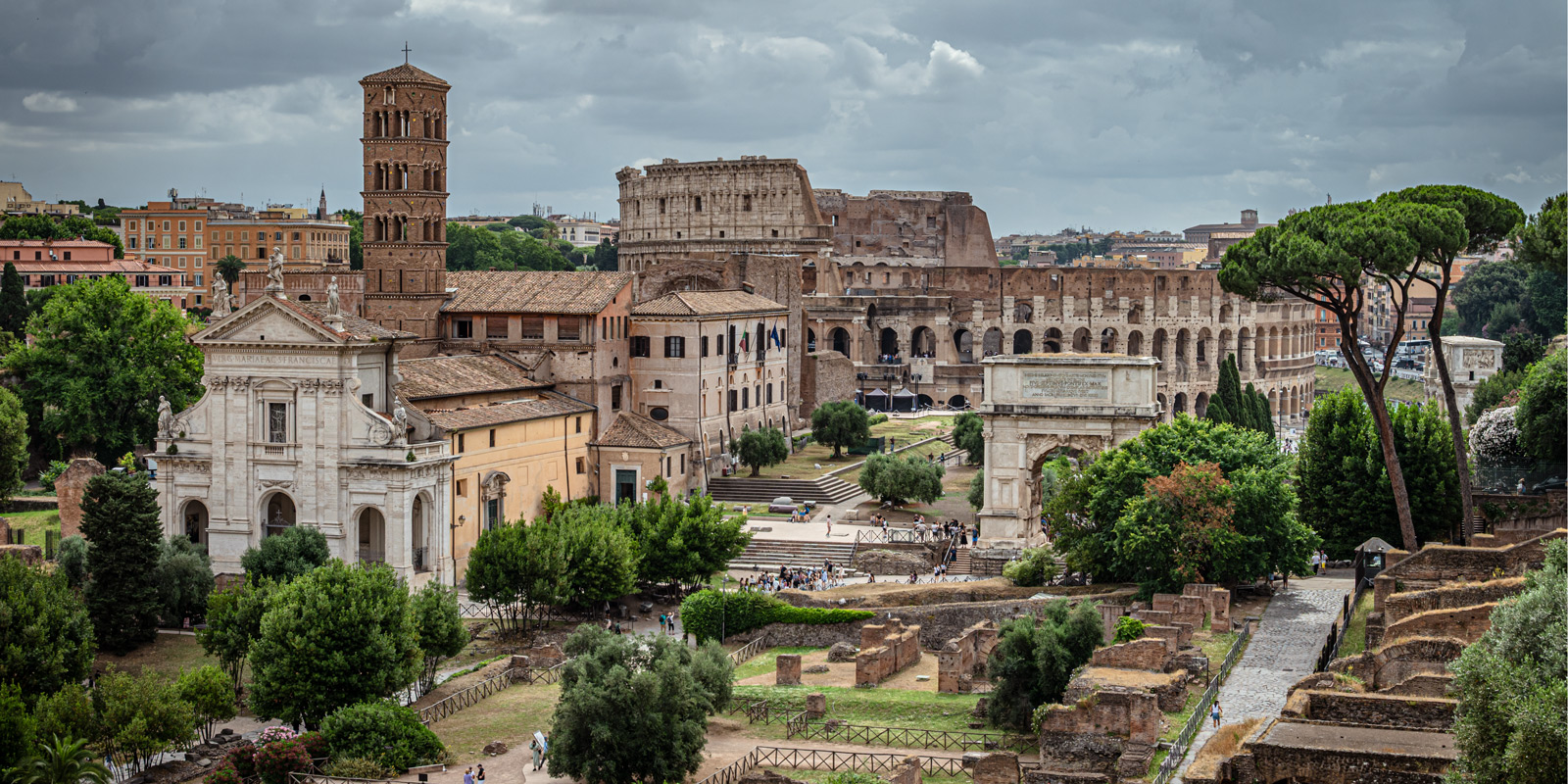
When you have finished with the Colosseum, Forum, or Palatine Hill, the wise choice is to linger in the ancient quarter rather than burning time crossing the city. Just east and south of the arena sits a tight knot of things to see near the Colosseum — churches, hills, and ruins that the average day-tripper never notices. Set off from the Arch of Constantine, work your way up the Monti rise to San Pietro in Vincoli for Michelangelo's Moses, descend into the stacked archaeology of San Clemente, continue to the Lateran, and then follow the Caelian Hill all the way down to your finish at Circus Maximus.
The beauty of the loop is that you almost never retread the same pavement. It also unfolds in rough chronological order: imperial victory at the opening, early Christian mosaics through the middle, medieval cloisters and Rome's own cathedral toward the end, and an enormous republican-era racecourse to close. Walk it end to end, or simply use it as a list and dip into whichever two or three interiors suit your energy.
Don't try to enter every single site. Interiors swallow time, and attempting all twelve stops in one afternoon is the surest path to sore feet and frayed tempers by the seventh. Stroll the entire line if you wish, but be selective about which doors you actually go through: San Pietro in Vincoli for the Michelangelo, San Clemente for its stacked archaeology, San Giovanni in Laterano for a headline basilica, and Santo Stefano Rotondo for the martyrdom cycle. Treat the viewpoints and the obelisk as quick pause-and-admire moments rather than full-blown visits.
The 4-Hour Route
Take the stops in the listed order; the route is arranged so you keep drifting gently outward and downhill away from the Colosseum, with no backtracking. Both San Giovanni in Laterano (stop 08) and Circus Maximus (stop 12) sit right next to a metro entrance, which makes them easy exit points if you want to peel off early without scrambling for a ride.

Go early and be choosy about interiors
Get to a key interior in the morning, ahead of the lengthy midday church closure, and pick only two or three to step inside instead of all twelve. Stops 08 and 12 are each beside a metro entrance, so you can break off cleanly the moment your legs have had enough.
- 01 Arch of Constantine
- 02 Santi Cosma e Damiano
- 03 Ponte degli Annibaldi viewpoint
- 04 Basilica of San Pietro in Vincoli
- 05 Basilica of San Clemente
- 06 Santi Quattro Coronati
- 07 Lateran Obelisk
- 08 Basilica of San Giovanni in Laterano
- 09 Basilica di Santo Stefano Rotondo al Celio
- 10 Santa Maria in Domnica
- 11 Basilica Santi Giovanni e Paolo
- 12 Circus Maximus
How to Use This Route
Commit to the interiors that matter to you
The character of this walk comes from San Pietro in Vincoli, San Clemente, San Giovanni in Laterano, and Santo Stefano Rotondo. Work out which of them you truly want to enter, plan your day around their opening hours, and let the remaining stops slot in around those anchors as exteriors you simply pass.
Church opening hours can wreck your schedule
Plenty of Roman churches shut for an extended midday pause and open again only in the late afternoon, while the smaller ones run on tight, unpredictable hours. Confirm that day's times before making a dedicated trip just to get inside, and try to reach any must-see interior in the morning rather than betting on the lunchtime lull.
Forum and Palatine already done? Cut it shorter
The archaeological park on its own is half a day on your feet. If you have already covered it, treat this as a curated shortlist rather than a second marathon: choose two interiors, stroll between them unhurried, and duck out at a metro stop as soon as your legs protest.
Stop-by-Stop Guide
Every stop below tackles the three things travelers really want to know about what to do near the Colosseum: why it deserves your time, what to seek out once you are inside, and when it is perfectly acceptable to walk on by. The walking times run point-to-point between consecutive stops, so you can total them up to build your own shorter loop.
Arch of Constantine
From Colosseum: 3 min walk
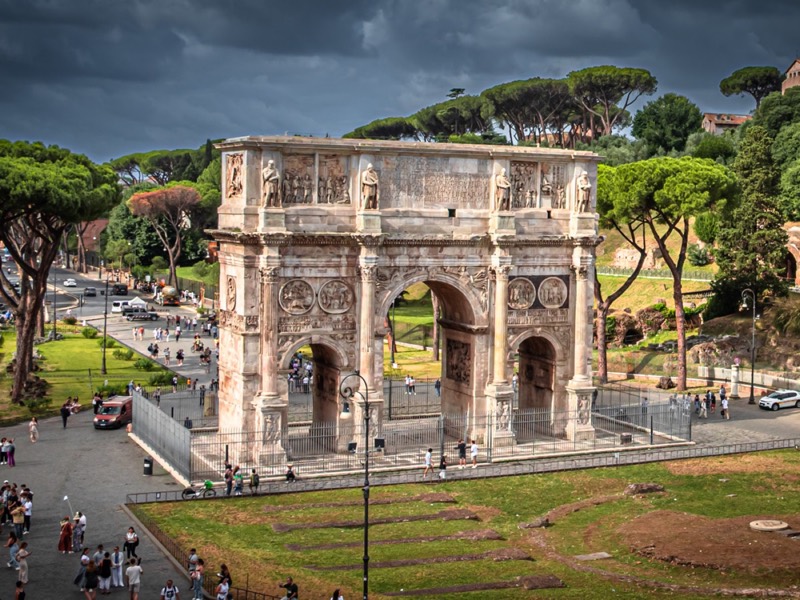
What it is: the biggest triumphal arch still standing in Rome, planted right next to the Colosseum and built to mark Constantine's win at the Milvian Bridge. A good deal of its carving was actually stripped from older monuments to Trajan, Hadrian, and Marcus Aurelius, then reinstalled here.
Do not miss: the relief panels, which you can read like a top-to-bottom storyboard. The salvaged older sculpture is visibly more refined than the fourth-century work commissioned for Constantine, and the moment you notice the gap you can't unsee it. This is propaganda carved in stone, not merely a photo prop.
Who it suits: absolutely everyone — it's free, it takes only minutes, and you walk right past it regardless.
Expert tip: position yourself on the Colosseum side for the tidiest photo, with the amphitheatre sitting behind the arch, then switch to the Palatine side to inspect the carvings up close away from the crush. It makes a perfect warm-up before you begin the climb up into Monti.
Santi Cosma e Damiano
From Arch of Constantine: 7 min walk
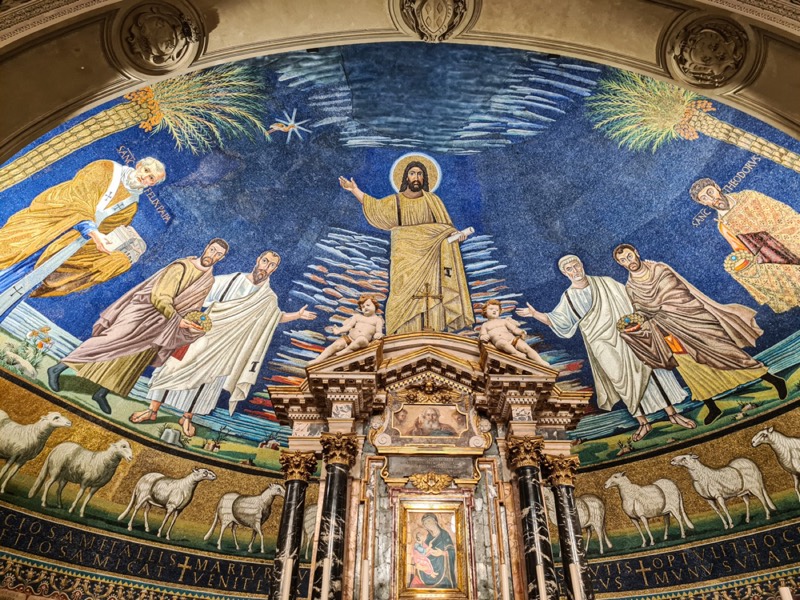
What it is: a sixth-century basilica slotted into ancient Roman Forum structures at the edge of the imperial fora, holding one of the city's most significant early Christian mosaics.
Do not miss: the gold-ground apse mosaic of Christ above the saints — one of the oldest of its type in Rome and a clear forerunner of the better-known mosaics waiting later at San Clemente and the Lateran. Keep an eye out, too, for the Neapolitan-style nativity scene, on show here all year.
Who it suits: anyone intrigued by the precise hinge where imperial Rome gave way to Christian Rome — this building literally straddles that seam.
Expert tip: very few stops bridge the Forum and Christian Rome this cleanly, so duck in if the doors are open. Opening hours are erratic, though; if the timing won't cooperate, enjoy the setting from the street and carry on with no regrets.
Ponte degli Annibaldi Viewpoint
From Santi Cosma e Damiano: 6 min walk
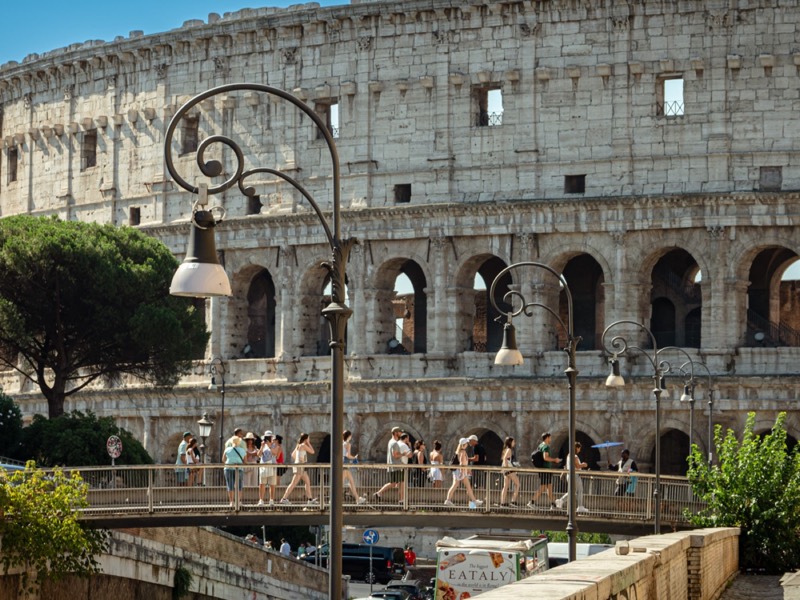
What it is: an ordinary road bridge that happens to offer a sweeping backward view of the Colosseum as you head up from the Forum's edge toward Monti and San Pietro in Vincoli. It isn't a monument — just a great vantage point.
Do not miss: the raised perspective. From up here the Colosseum, the rear of the Forum, and the Monti slope all line up in a single frame, and the whole walk's geography suddenly makes sense.
Who it suits: photographers, plus anyone who likes to get their bearings before moving on.
Expert tip: think of it as a thirty-second breather, not a stop in its own right. The light is best earlier in the day, before the sun drops behind the amphitheatre; come later and you'll be shooting straight into the glare.
Basilica of San Pietro in Vincoli
From viewpoint: 4 min walk
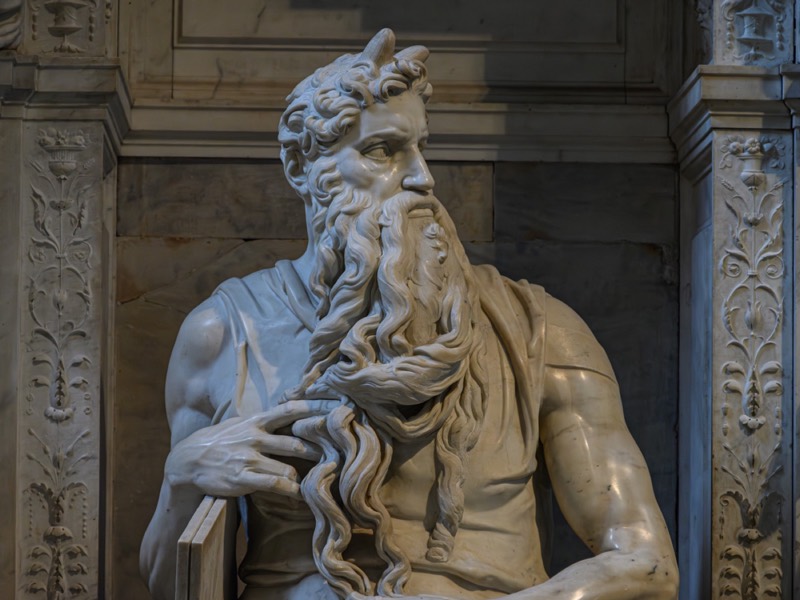
What it is: an unassuming basilica with two giant draws — Michelangelo's Moses, sculpted for the never-finished tomb of Pope Julius II, and the relic honoured as the chains (vincoli) that once held St. Peter, from which the church takes its name.
Do not miss: the Moses in the right transept, with its celebrated horns (a quirk of translation from the Hebrew) and the wound-up tension Michelangelo poured into the seated figure. Then find the reliquary of the chains in its case below the high altar. Carry a coin or two for the light box that lights up the statue.
Who it suits: art lovers most of all — this is the most rewarding interior on the entire route and one of the best things to see near the Colosseum, yet it asks for only twenty minutes and charges nothing.
Expert tip: arrive early or late to sidestep the tour groups that pour through at midday. The Domus Aurea entrance on Colle Oppio shares this same hill; since it runs on timed tickets, schedule it as a separately booked extra rather than an impromptu free-walk stop.
Basilica of San Clemente
From San Pietro in Vincoli: 12 min walk
What it is: the most legible cross-section of Rome you can actually walk down through — a twelfth-century basilica raised over a fourth-century church, which itself rests on first-century Roman buildings and a temple to the god Mithras, with an ancient stream still gurgling at the deepest level.
Do not miss: the shimmering golden apse mosaic of the Tree of Life in the upper church, followed by the ticketed descent through the strata to the Mithraic altar. Every staircase carries you roughly a thousand years further down into the city.
Who it suits: anyone wanting the single clearest proof of how Rome was literally stacked on top of itself; the underground is the star turn, so it pays off for those with a little stamina.
Expert tip: if you only have appetite for one archaeological church near the Colosseum, choose this one. The lower floors are cool, damp, and low-ceilinged, doubling as a refreshing escape on a sweltering afternoon — though they're best avoided if stairs or cramped spaces unsettle you.
Santi Quattro Coronati
From San Clemente: 3 min walk
What it is: a fortress-like medieval monastery that still operates as a living convent, complete with quiet courtyards, a delicate Cosmatesque cloister, and the frescoed Chapel of San Silvestro tucked behind the gate.
Do not miss: the inner cloister and, when it's open, the San Silvestro chapel with its rare thirteenth-century frescoes recounting the legend of Constantine and Pope Sylvester. Reaching the chapel often means passing through the convent's enclosure, occasionally via a turnstile and a small donation, so patience and a soft voice go a long way.
Who it suits: travelers who favour hidden Rome over marquee monuments and won't mind if part of it happens to be shut that day.
Expert tip: it lies barely three minutes from San Clemente yet feels a universe removed from the Colosseum crowds. Speak quietly — nuns still live here — and the cloister will most likely be yours alone.
Lateran Obelisk
From Santi Quattro Coronati: 10-12 min walk
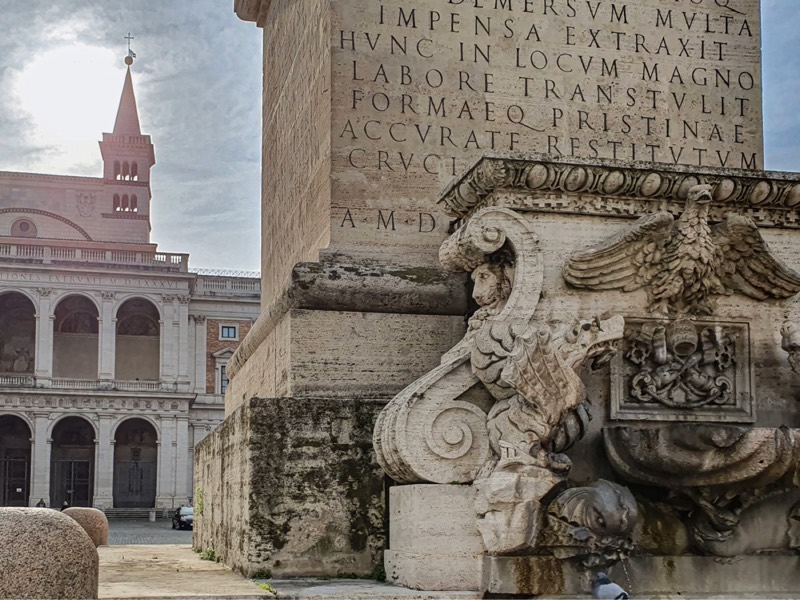
What it is: the tallest ancient Egyptian obelisk anywhere on earth, first carved for a temple at Thebes, shipped to Rome, and finally re-raised here next to San Giovanni in Laterano.
Do not miss: the sheer height, best felt by stepping right up to the base and tilting your head straight up the shaft. It functions as the anchor of the Lateran square rather than a spot to linger over on its own.
Who it suits: anyone who relishes Rome's habit of recycling its empire — an Egyptian monument repurposed to crown a Christian piazza.
Expert tip: soak it in from the open square before stepping into the basilica next door. Catching the two together in one glance captures the whole sweep of the walk — pharaoh, emperor, and pope sharing one piazza.
Basilica of San Giovanni in Laterano
From Lateran Obelisk: 2 min walk
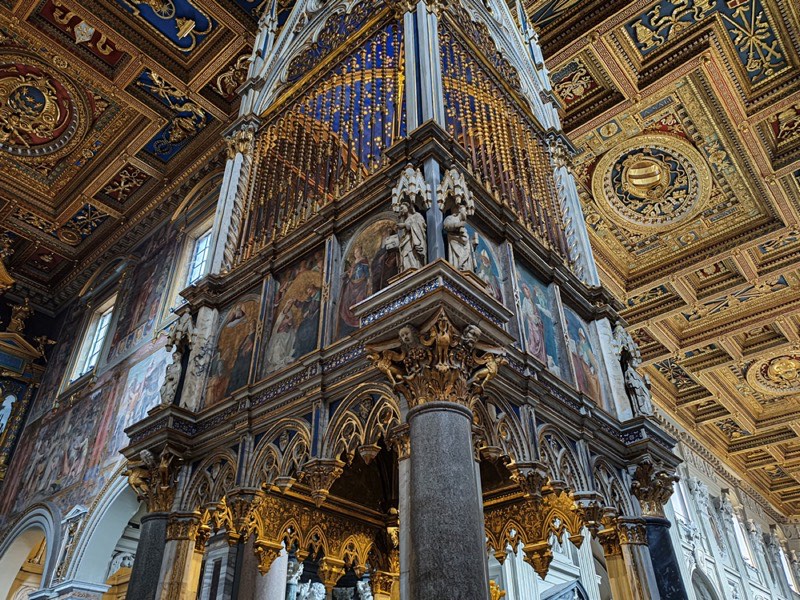
What it is: Rome's cathedral and the Pope's own bishop's seat — which, in strict church protocol, actually outranks St. Peter's, something most visitors sprinting to the Vatican never grasp. It's the oldest of the city's four major basilicas.
Do not miss: the towering Apostle statues down the nave, the Gothic canopy crowning the papal altar, the gilded coffered ceiling, and the peaceful thirteenth-century cloister with its twisted Cosmatesque columns, if you can spare the extra time and modest fee.
Who it suits: anyone wanting one truly magnificent basilica on the route, and travelers who'd rather close on a major landmark than a hushed little church.
Expert tip: this is the best early exit on the entire walk. If your energy is flagging, wrap up here and hop on San Giovanni metro on Line A, which whisks you back near Termini and the main hotel district in minutes.
Basilica di Santo Stefano Rotondo al Celio
From San Giovanni in Laterano: 12-15 min walk
What it is: one of the world's oldest circular churches, a fifth-century basilica on the Caelian Hill encircled by a famously graphic cycle of sixteenth-century martyrdom frescoes.
Do not miss: the way the round floor plan and ring of columns draw your gaze around the room, and then the frescoes themselves. A heads-up: the scenes show martyrdoms in unsparing detail — deliberately confronting, intended as devotional memory rather than shock value.
Who it suits: visitors fascinated by early Christian history and unconventional architecture; probably not the ideal stop for small children or the faint of heart.
Expert tip: the interior is still and dim, a sharp contrast to the splendour of the Lateran you've just left. Hours are limited, so verify them before walking over; if it's closed or simply not for you, push straight on to Santa Maria in Domnica two minutes away.
Santa Maria in Domnica
From Santo Stefano Rotondo: 2 min walk
What it is: a peaceful old church on the Caelian Hill with a radiant ninth-century apse mosaic, set behind the Navicella — a Renaissance fountain carved like an ancient stone boat that lends the church its nickname.
Do not miss: the apse mosaic of the enthroned Virgin amid a throng of angels, aglow against a deep blue field, should you find the doors open. If they're locked, the little boat fountain outside is a delightful excuse to pause before moving on.
Who it suits: mosaic fans and anyone content to treat it as a fortunate bonus rather than a guaranteed visit.
Expert tip: its hours are brief and erratic, so never pin your schedule on getting inside. Enjoy the fountain, glance in if you can, and keep heading toward Santi Giovanni e Paolo.
Basilica Santi Giovanni e Paolo
From Santa Maria in Domnica: 6 min walk
What it is: a basilica built around the martyr tradition of Saints John and Paul, raised straight over a maze of Roman houses (the Case Romane del Celio) on the Caelian Hill.
Do not miss: the church interior at ground level and — time and opening hours permitting — the separately ticketed Roman Houses beneath, where you can wander rooms that still bear traces of pagan and early Christian wall painting.
Who it suits: anyone who loved San Clemente and fancies a second, quieter helping of underground Rome before the route wraps up.
Expert tip: the houses are the real reason to stay, and they carry their own ticket and opening window, so check ahead. Skip them and this is a quick church stop; include them and allow closer to the upper end of the time estimate before the final drop down to Circus Maximus.
Circus Maximus
From Santi Giovanni e Paolo: 10-12 min walk
What it is: ancient Rome's vast chariot-racing arena — which once packed in crowds far bigger than the Colosseum — today a long grassy basin with open sightlines up to the Palatine palaces on one flank and the Aventine Hill on the other.
Do not miss: the sheer scale of it. Little actual ruin survives, so the joy lies in standing where the track once curved and imagining a quarter-million Romans bellowing at the horses. The level grass also makes a great place to rest your legs after the walk.
Who it suits: everyone, as a free, open-air finale; especially lovely at golden hour when the Palatine ruins glow above you.
Expert tip: finish here, because Circo Massimo metro is right alongside and your onward choices are all simple — catch the metro, climb the Aventine Hill for the famous keyhole view, or amble toward Tiber Island and dinner in Trastevere.
How to Shorten the Route
60-90 minutes
Do: the Arch of Constantine, the Ponte degli Annibaldi viewpoint, and then San Pietro in Vincoli for the Moses, before looping back toward the Colosseum or up into Monti for a coffee.
Best for: a narrow gap between timed tickets, when you want a single great interior and a photo without signing up for a long walk.
2 hours
Do: San Pietro in Vincoli, the stacked levels of San Clemente, and the still cloister of Santi Quattro Coronati, then let your legs decide whether to continue to the Lateran.
Best for: a concentrated hit of art and archaeology without the longer Caelian Hill leg.
3 hours
Do: the whole run up to San Giovanni in Laterano, then wrap up at San Giovanni metro on Line A if you're running out of steam.
Best for: taking in one truly grand basilica to close, and ending right beside a station for an effortless ride back.
Full 4 hours
Do: push on from the Lateran over the Caelian Hill — Santo Stefano Rotondo, Santa Maria in Domnica, Santi Giovanni e Paolo — and down to Circus Maximus.
Best for: a complete, leisurely day when you're after the quiet hill churches the crowds never find.
After Circus Maximus
Wrap up easily at Circo Massimo
Circo Massimo station on Line B is right next to the track, making it the fuss-free exit when the walk has been plenty and you simply want to reach your hotel without making one more decision.
Carry on to the Aventine Hill
If there's still gas in the tank, climb the Aventine for its orange garden, a serene terrace scented with roses looking out over the city, and the celebrated keyhole view through the Knights of Malta door. It's the soft, green counterpoint to a day spent among ruins.
Head toward Tiber Island and Trastevere
If you've finished in the late afternoon, wander down to the river, cross over at Tiber Island, and let the lanes of Trastevere draw you toward an aperitivo and dinner as the light turns golden.
Things to Know
What is next to the Colosseum in Rome?
The Arch of Constantine rises right alongside the Colosseum, only a few steps from the exit. The Roman Forum and Palatine Hill belong to the same archaeological park, and both the Ludus Magnus (the gladiators' training ground) and the grand boulevard of Via dei Fori Imperiali are a short walk off. Nearly every attraction near the Colosseum on this route starts within five minutes of the arena.
What are the best attractions near the Colosseum in Rome?
If history beats shopping for you, the top picks are San Pietro in Vincoli (Michelangelo's Moses), San Clemente (a church layered over Roman ruins and a Mithraic temple), Santi Quattro Coronati (a quiet medieval monastery), and San Giovanni in Laterano (Rome's actual cathedral). Between them they cover ancient strata, early Christian mosaics, relics, and a major basilica — far richer than the Colosseum-and-Forum loop on its own, and most are free or cheap to enter.
Can I walk from the Colosseum to San Giovanni in Laterano?
Yes, easily. It's a gentle walk that feels even shorter once you punctuate it with San Clemente and Santi Quattro Coronati en route, so the journey itself becomes the sightseeing. On arrival, San Giovanni metro on Line A sits right there if you'd sooner ride back than retrace your steps.
Is this route good after the Roman Forum and Palatine Hill?
Yes, just pace yourself. The Forum and Palatine already mean a long spell on your feet, so instead of entering every church, single out two or three interiors that really appeal — say San Pietro in Vincoli plus San Clemente — and treat the rest as exteriors you walk past. You'll catch the highlights and still have legs left for dinner.
Where does the route end?
The complete route closes at Circus Maximus, right next to Circo Massimo metro. From there your options are straightforward: step into the station and head home, climb the Aventine Hill for its gardens and keyhole view, or drift toward Tiber Island and Trastevere as evening falls.