4.8/5 (12,400 reviews)
Secure Booking
Free Cancellation
Mobile Tickets
2M+ Tickets Sold
Domus Aurea: Nero's Golden House Next to the Colosseum
1Why it matters
The Colosseum sits on the very ground that once held Nero's private lake.
2Visit days
Right now the official calendar opens only on Fridays, Saturdays and Sundays.
3Best pairing
Pair the visit with the Colosseum, Oppian Hill, Roman Forum, or Monti.
For anyone who wants the fuller backstory of the area, the Domus Aurea —
Nero's Golden House — is among the most rewarding things to visit near the
Colosseum. This is no ordinary stop beside the arena: it reveals why the Colosseum
was placed in this particular valley and how the Flavian emperors reshaped Nero's private estate
into a monument for the public.
Separate ticketNever bundled into the Colosseum pass
Timed guided entryEducational tour on fixed time slots
Steps from the ColosseumA brief climb up Colle Oppio
Nero's frescoed hallsWalk through the buried rooms of the palace
Quick Answer
Built by Nero after the AD 64 Great Fire, the Domus Aurea was a palace on
a staggering scale. Its grounds rolled out gardens, dining rooms, ornate halls, and the
man-made lake that filled the valley now occupied by the Colosseum. For travellers who
want the richest piece of history to visit near the Colosseum, few options
carry more meaning than Nero's golden house.
AD 64Nero starts the palace once the fire dies down
Fri-Sundays the official visit currently runs
€26usual price of the official educational tour
€47typical partner tour price once official slots sell out
Domus Aurea Tickets and Tour Options
Official first
Official Domus Aurea educational tour
Always start with the official ticketing system, but be aware the only product on sale is
the Domus Aurea - Educational Tour. There is no ordinary self-guided
entry; every visit is organised around timed guided tours.
The genuine official option: educational tour plus ticket, normally €26
No plain stand-alone ticket exists for exploring on your own
English departures book up well in advance; try Spanish, Italian, or French if you can be flexible
When the official times do not line up, or you simply want a live English commentary, a
partner-run Domus Aurea tour fills the gap. Treat it as your back-up
plan and check it early whenever the official English educational tours are gone for your dates.
Fully guided walk through the Domus Aurea
Frequently about €47, depending on the date and the provider's terms
Slots on the English educational tour can disappear months in advance, so reserve as soon
as your dates are set. If they have already gone, look at the partner guided tour or a
different language departure instead of holding out until the last minute.
What matters when booking
No self-guided visit: the only way in is the Educational Tour format.
English sells out first: English-language departures tend to close
earliest, sometimes a few months before the date.
Try other languages: Spanish, Italian, and French slots often survive
after the English ones have vanished.
Use the fallback early: when no official slot fits, secure the partner
guided tour ahead of time rather than gambling on the last day.
Booking note: opening times, closures, prices, available languages, and
partner conditions all shift over time. Confirm everything on the live booking page before you
plan the rest of your Colosseum day around the Domus Aurea.
What Is the Domus Aurea?
Picture Nero's Golden House as an expansive pleasure-palace rather than one
hall or a museum wing. It once spread across a large slice of central Rome, yet the rooms you
can genuinely walk today lie mostly underneath the Oppian Hill.
What it was
A sweeping imperial estate of buildings, gardens, woodland, vineyards, ornate halls,
baths, dining rooms, and Nero's celebrated man-made lake.
What you see today
The accessible rooms are chiefly the surviving spaces beside and above the Colosseum,
not the entire estate that ancient writers describe.
Why it feels underground
Emperors who followed filled in and recycled stretches of Nero's palace as foundations.
Ironically, that burial shielded the painted rooms and, centuries later, drew Renaissance
artists who crept into the chambers and called them "grottoes."
Site context
How Domus Aurea Is Connected to the Colosseum
Why the Colosseum stands exactly here
At heart, the connection comes down to land and politics. The
Domus Aurea kept its own decorative lake in the valley between Rome's hills. After Nero's
fall, the Flavian emperors drained that private lake
and built the Colosseum directly on top of it — a deliberate handing back of Nero's
pleasure-grounds to the people of Rome.
The gesture was as much a message as a construction job. By rising where Nero's private palace
had swallowed the land, the new amphitheatre announced that the ground was now the people's,
given over to public spectacle.
Visitor angle: where the Colosseum tells you "what Rome built here," the
Domus Aurea explains "what stood here first, and why the Flavians swept it away."
Can You Visit Domus Aurea Today?
Yes, but do not expect an open-all-hours monument you can stroll into like a piazza. The
official Parco archeologico del Colosseo presently runs Domus Aurea visits on
Fridays, Saturdays and Sundays, all on timed slots with scheduled entry.
Because it stays near 10 degrees Celsius inside, the official page urges you to bring
comfortable shoes and warm enough clothing. Approach it as a controlled archaeological visit
rather than a relaxed museum drop-in.
When planning, never assume you can grab a ticket and wander in at will. The official booking
system is built around language-specific time slots, and every visit is run as an
educational tour.
Where Is the Entrance?
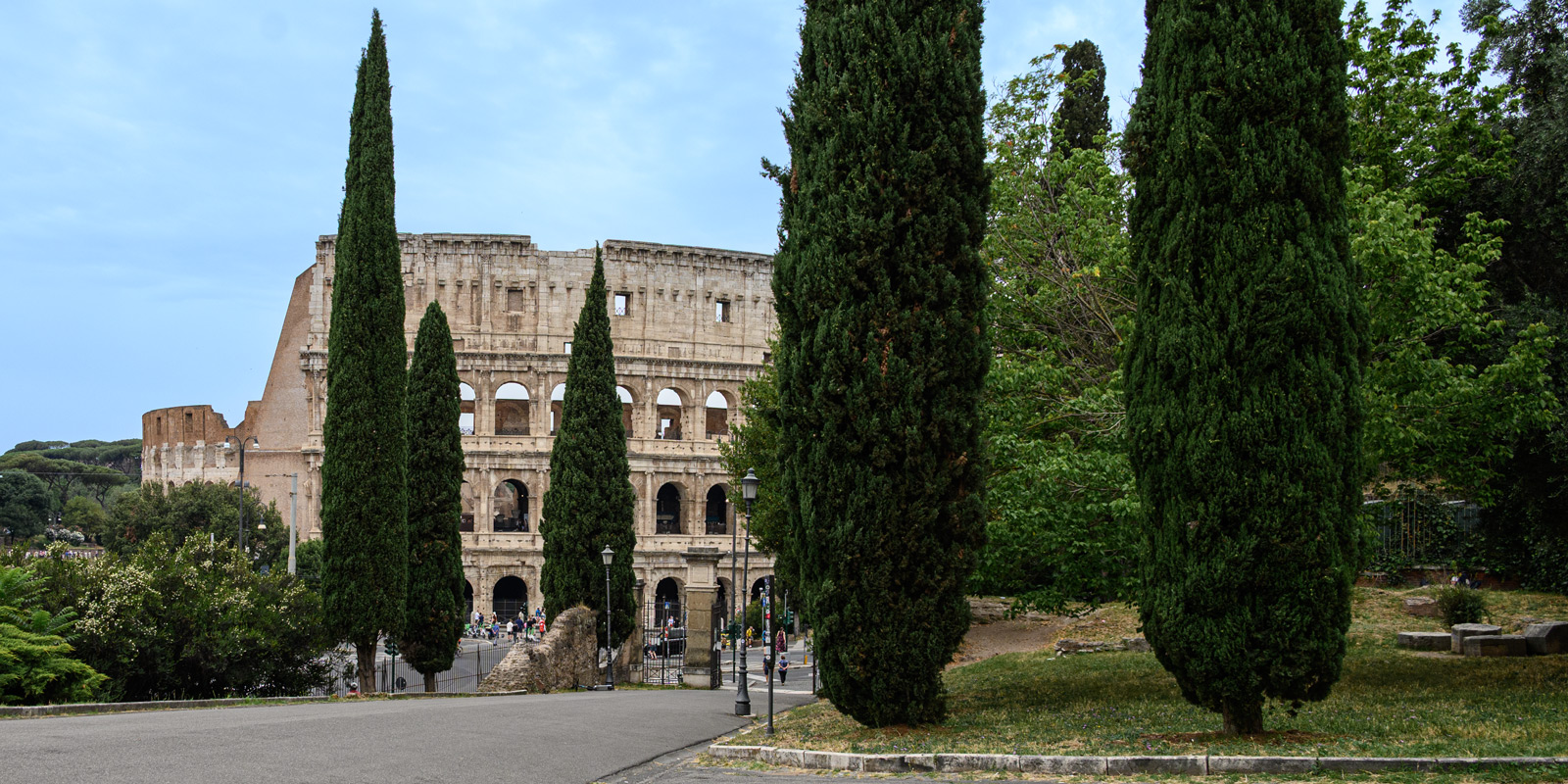
The Domus Aurea sits on Colle Oppio, the hill rising above the Colosseum. The
official pages place the entrance near Viale della Domus Aurea / Via Labicana, within the
Colle Oppio park. Coming from the Colosseum, count on a short uphill walk
rather than any cross-city journey.
Walk
From the Colosseum
Normally a brief climb toward Colle Oppio. Allow a little buffer to pinpoint the right
entrance.
About 10 minutes
B
Metro
Take Colosseo on Metro Line B, or Colosseo - Fori Imperiali wherever Line C is in service.
Closest stop: Colosseo
Bus
Bus or Tram
The official page points to nearby bus routes 51, 85, 87 and tram 3. Confirm live transit
before you set off.
Best for nearby Rome areas
Is Domus Aurea Worth Visiting?
Best for
Colosseum context
Nothing explains better why the Colosseum ended up in this precise valley.
Best for
Nero and archaeology
The tour layers in Nero, buried chambers, frescoes, the Renaissance rediscovery, and
live conservation work.
Skip if
You want a simple add-on
Fixed time slots and only a few open days make it harder to fit in than free-roaming
attractions near the Colosseum
such as the Roman Forum edge or Monti.
Domus Aurea vs Colosseum: Should You Visit Both?
Choose the Colosseum if...
The iconic amphitheatre is your priority.
Your time in Rome is tight.
You are after arena architecture, Roman spectacle, and the classic ancient-Rome visit.
Add Domus Aurea if...
You are curious about what occupied this site before the amphitheatre.
Nero, palace architecture, frescoes, or buried Roman interiors appeal to you.
Your dates can line up with Friday, Saturday, or Sunday availability.
What You Actually See Inside
Down below, the experience feels less like a gallery and more like threading through the
working heart of Nero's pavilion — long brick passages, towering vaults, and the celebrated
eight-sided centrepiece, all brought back to life by projected reconstruction.
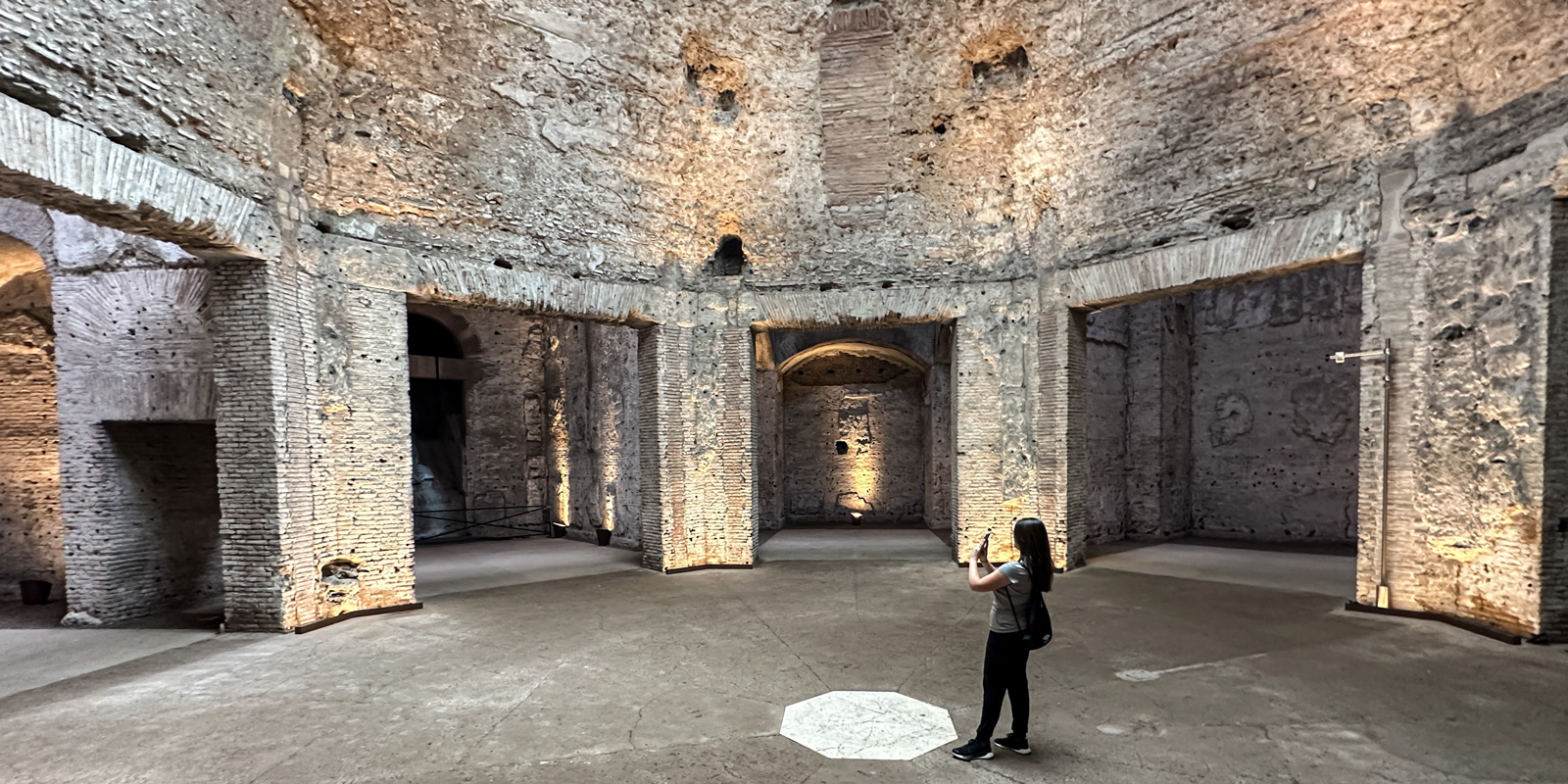
The octagonal room
The Sala Ottagona steals the show — an eight-sided hall crowned by a concrete dome with a
broad central oculus, raised in the AD 60s by the architects Severus and Celer. Daylight
floods through it into the buried core, anticipating the engineering of the Pantheon dome
by around fifty years.
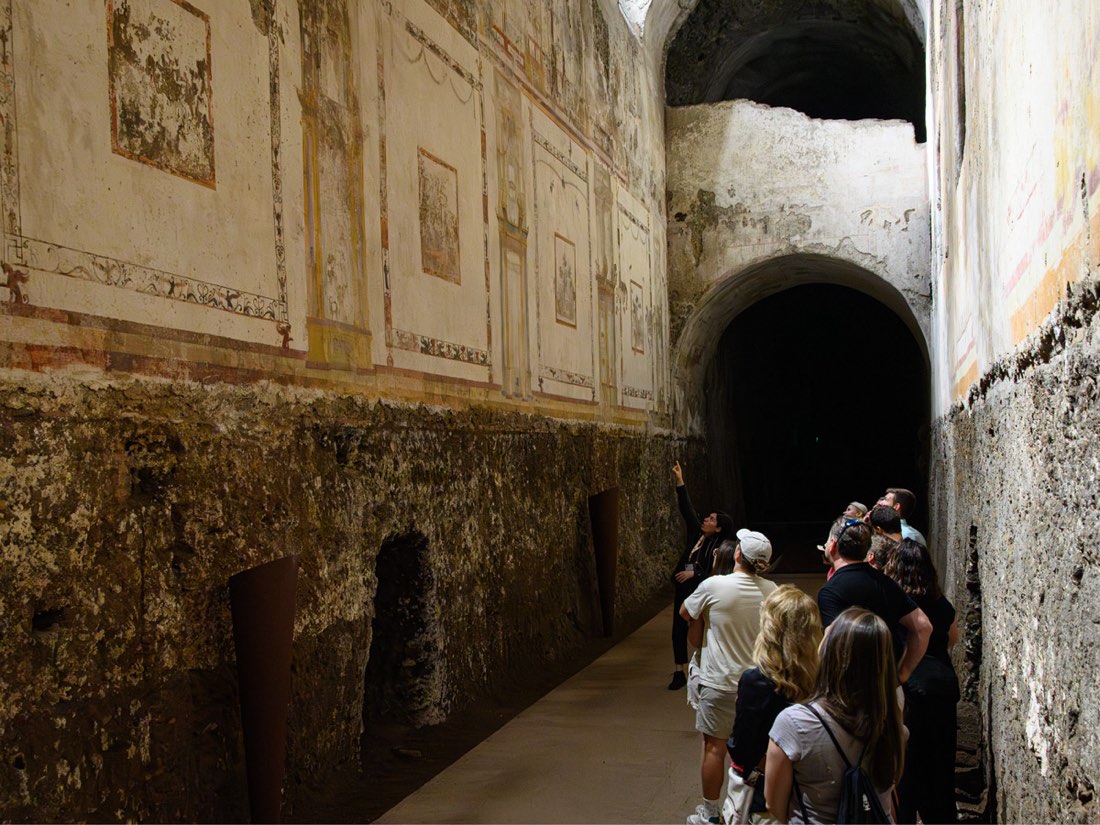
Cryptoporticus corridors
Your route follows the cryptoporticus, the vaulted service passages that once tied the
pavilion's rooms together. Cool and damp at roughly 10 degrees, they are exactly why the
guides press you to bring a jacket; their plaster still bears faint sgraffiti scratched by
later visitors.
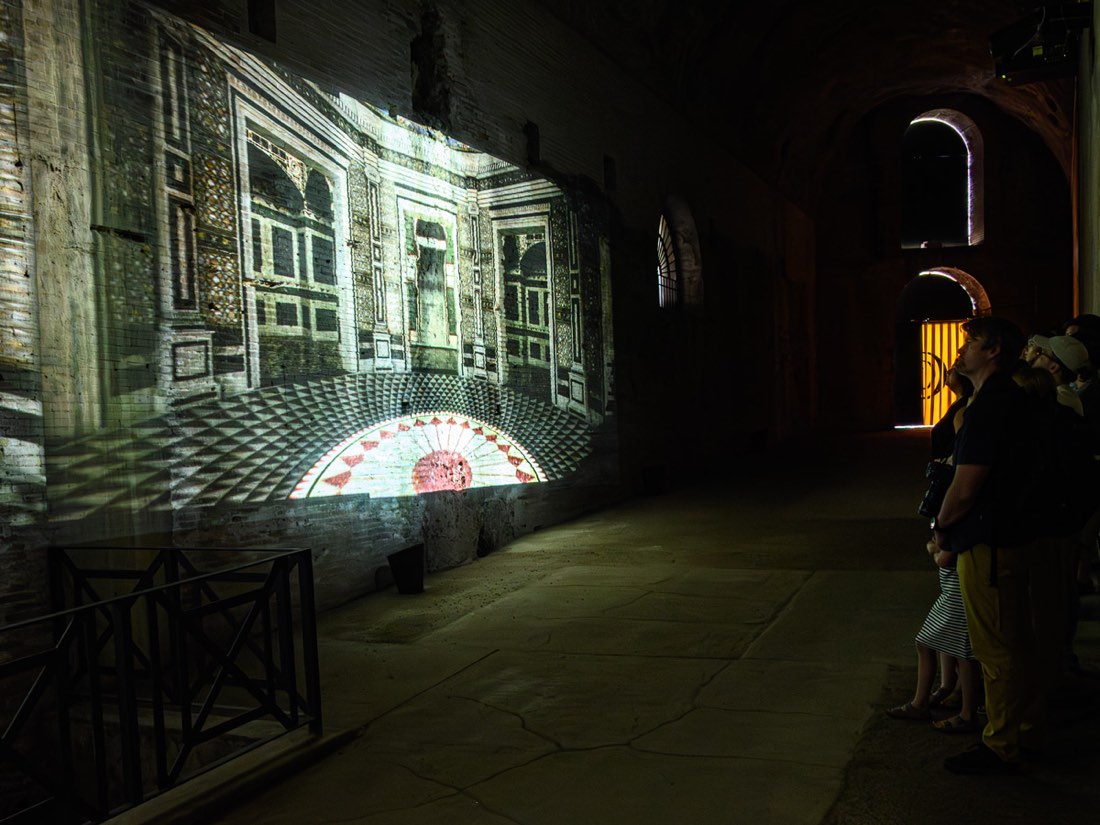
Surviving frescoes and the VR tour
Only scraps of the original paint remain — fragments of red and ochre panels, fine
candelabra motifs, the odd patch of stucco. This is where the Domus Aurea VR
experience earns its place: the educational tour fits you with a VR headset that
restores the gilded ceilings, marble facing, and lost lake view right over the rubble at
your feet.
The Grottesche: How a Buried Palace Renamed an Entire Style
The chambers came to light around 1480 by sheer chance, when Romans who slipped through gaps
in the Oppian Hill landed in painted rooms they mistook for caves, or grotte. The
news travelled quickly through artistic circles. Pinturicchio, Raphael, Giovanni da Udine, and
reportedly a young Michelangelo had themselves lowered on ropes into the half-flooded vaults,
lifting torches to the ceilings and sketching the bizarre painted fantasies overhead.
These motifs — thin candelabra, hybrid beasts, garlands, masks, and impossible architecture
drifting across flat fields of colour — took the name grottesche from the
"grottoes" that had concealed them, giving us the modern word "grotesque." In the 1510s
Raphael and his workshop carried them straight onto the walls of the Vatican Loggie, and from
there the manner spread right across Renaissance Europe. The names those artists scratched into
the plaster, several still readable today, mark the point at which Nero's vanished decoration
rejoined the western canon.
Why it matters on the visit: the faded Renaissance signatures sit on the very
same walls as the ancient Roman painting, so one room carries two eras of art history side by side.
Why Access Stays So Limited
Water is by far the biggest enemy. Lying right under the park and gardens of Colle Oppio,
the Domus Aurea has for centuries taken in rain that filters through the soil and drags
moisture and roots into the vaults, breaking down binders and peeling away what plaster
remains. The burial that once safeguarded the frescoes has become the main cause of their ruin.
Since the 2010s the conservation effort has targeted the hill overhead just as much as the
chambers underneath — swapping heavy earth for lighter, free-draining layers and engineered
planting meant to slow the water reaching the ceilings. That delicacy, together with the
cool, humid microclimate, is why entry stays limited to small timed groups on a few days a
week instead of open general admission.
See It With a Guide Who Knows the Rooms
Plan the visit
Guided Domus Aurea visit
With no self-guided entry and places in short supply, a Domus Aurea tour
is really the only practical way in. A strong guide weaves together what still survives, what
the VR headset rebuilds, and the Renaissance artists who once climbed down these walls —
turning a dim corridor into a layered tale of the octagonal hall, the grottesche, and Nero's
lost lake.
Best for first-timers: make your
Colosseum ticket the anchor of the day, then slot
in the Domus Aurea only if its timed entry fits without a rush.
Domus Aurea first
Best for Nero focus: open with the palace story, then head downhill to
the Colosseum the Flavians raised over Nero's lake.
With Roman Forum
Best ancient Rome day: the Colosseum, the Domus Aurea, and some
Forum/Palatine time can all fit, but resist stacking back-to-back entries too tightly.
With Monti
Best relaxed finish: once you leave the Domus Aurea, stroll into Monti for
coffee, lunch, or dinner
instead of adding another major monument.
Official Sources to Check Before Booking
Lean on the official area page for current visit rules, closures, and final prices. Keep the
GetYourGuide tours as comparison options for when the official educational tour has sold out
or the leftover languages do not suit your group.
The Domus Aurea was the enormous palace estate Nero built across Rome in the
years after the AD 64 Great Fire. The part you can visit now lies mostly under
the Oppian Hill, a short walk from the Colosseum.
How is Domus Aurea connected to the Colosseum?
The valley the Colosseum fills was once home to Nero's man-made lake, part of
the Domus Aurea grounds. Because the amphitheatre rose on that spot, it stays
bound to Nero's golden house both physically and as a political symbol.
Can you visit Domus Aurea today?
Yes, though access is restricted. The official Parco archeologico del Colosseo currently
schedules visits on Fridays, Saturdays and Sundays only, with timed entry and a limited
number of places.
How much are Domus Aurea tickets?
Entry is offered only through the Educational Tour format. Booked directly with the
official channel it is usually around €26. Once those slots have sold out, partner
guided tours typically run near €47, varying by date and conditions.
Where is the Domus Aurea entrance?
You will find it up on Colle Oppio, near Viale della Domus Aurea / Via Labicana,
just above the Colosseum. Since entry is timed, leave a few spare minutes to locate
the gate before your slot.
Is Domus Aurea better before or after the Colosseum?
Both orders work fine. On a first trip, lock in the Colosseum ticket first and slot
Domus Aurea around it. Visitors who care most about the history often do
Domus Aurea first, then see the Colosseum as the Flavian answer that buried
Nero's lake.