
Interesting Facts About the
Colosseum
Looking for genuinely interesting facts about the Colosseum? This ancient arena packed in tens of thousands of spectators, survived the fall of Rome, and is still standing close to 2,000 years on. The 50 Colosseum facts below — covering everything from the engineering behind it to the legends it sparked — are here to enrich your visit far beyond what the view from the stands reveals.
-
 Built AD 72–80
 -
 Capacity 50,000–80,000
 -
 Materials Concrete & travertine
 - Inaugural games 100 days
A brutal opening spectacle
The Colosseum's first 100 days of games left over 9,000 wild animals dead in the arena.
Origins & Construction
- The name "Colosseum" most probably traces back to the towering bronze figure called the Colossus of Nero, which once rose close to the amphitheater. The statue first belonged to the grounds of Nero's Domus Aurea, the emperor's private palace estate that the public arena later displaced. Cast as a badge of Nero's authority, the giant figure ended up lending the Colosseum the name we still use today.
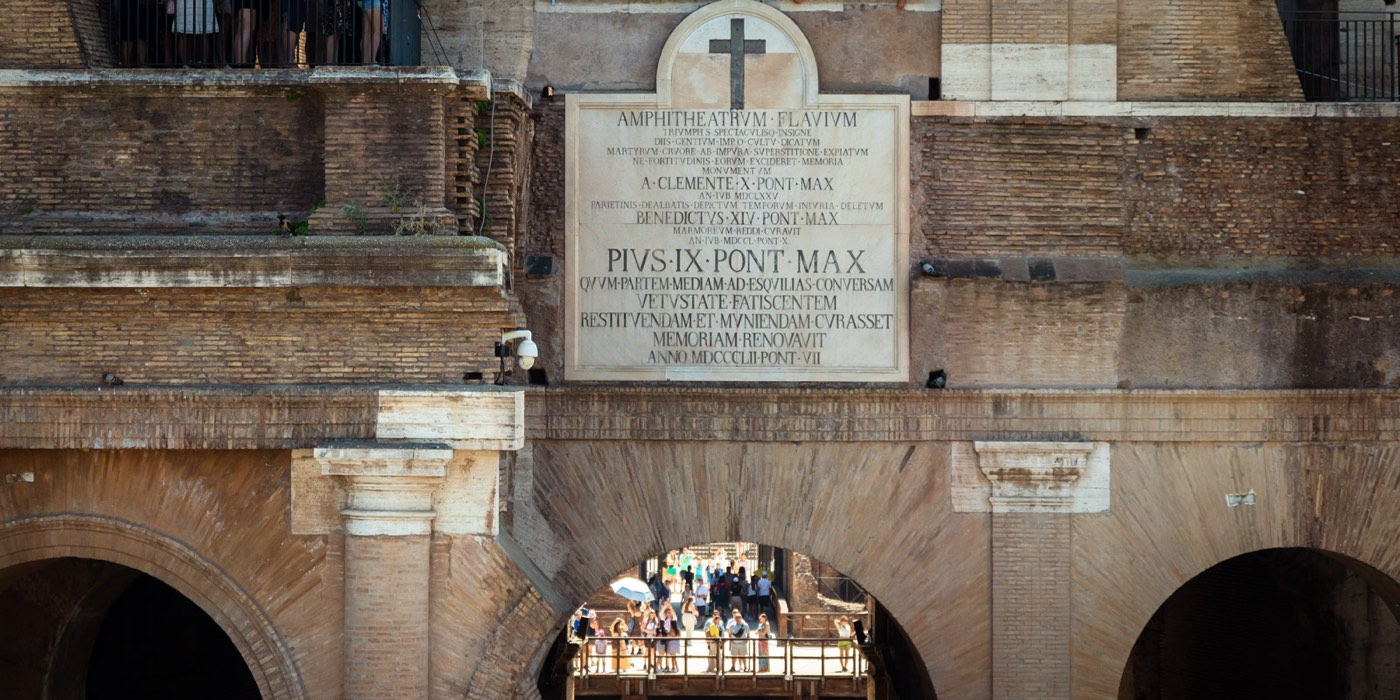
- The Flavian Amphitheater is the building's formal title, chosen to credit the Flavian line of emperors who drove the project forward. That dynasty took in Vespasian alongside his sons Titus and Domitian, each of whom shaped its building and its earliest years of use.
- Vespasian set the project in motion, and construction commenced around AD 72 before wrapping up by AD 80 under his son Titus. Finishing on that timescale spoke to Roman engineering skill and was intended to signal Rome's recovery once the civil wars had passed.
- Built mainly from concrete and sand and faced with travertine limestone, the Colosseum remains a striking showcase of Roman building materials and methods, the kind that have endured for two millennia.
- That thousands of slaves were put to work raising the Colosseum is a blunt reminder of how the Roman Empire's economy and society actually ran, where breathtaking grandeur sat right beside outright exploitation.
- Raising the Colosseum marked a defining moment in ancient Rome's urban development, arriving in an era of rapid growth and change for the city and standing as proof of just how powerful and sophisticated Roman civilization had become at its height.
Engineering & Design
- Best estimates put the Colosseum's capacity somewhere between 50,000 and 80,000 spectators — a size and capacity that ranked it among the ancient world's biggest venues and let it seat a sizeable share of Rome's residents at once.
- The velarium counts as one of its cleverest touches. This enormous pull-out awning kept the sun off the crowd, a piece of Roman design ingenuity that also reveals how much thought went into spectator comfort during games that ran long and turned grisly.
- The hypogeum — a maze of tunnels and chambers dug beneath the arena — handled the behind-the-scenes logistics, holding gladiators and beasts out of sight until they were lifted up into view, which kept the spectacle unpredictable and tense.
- Beyond pure Roman architectural and engineering excellence, the Colosseum reveals how well the society could organise itself, from coordinating the build to running the events staged within its walls.
- The design rose through four distinct tiers, each with its own role: arched openings eased access on the lower floors while plain rectangular windows topped the highest level, a layout that reflects Roman precision and a clear sense of structural rank.
- In their original state, the arches along the middle storeys were filled with statues, ornament that did more than look impressive — it broadcast the empire's wealth and artistry and hints at the creative ambitions of the age.
- Choosing an elliptical shape was a calculated move: it cut the danger of a crush in the crowd and gave every seat a clear line to the action, evidence of how shrewdly the Romans thought about crowd safety and sightlines.
- The arena's floor was cleverly laid in timber and topped with sand to soak up the blood spilled in the fights, a down-to-earth fix that kept the venue usable and presentable through its constant, often gory, programme.
- Hidden trapdoors and sophisticated machinery let beasts and gladiators burst suddenly into the arena, a flourish that heightened the drama and again points to just how skilled Roman engineers were.
- Mounting mock sea battles called for a sophisticated drainage system capable of flooding the arena and emptying it again, proof of Roman mastery of hydraulics and their taste for sweeping, immersive shows.
- Boasting more than 80 entrances and exits, the Colosseum was tuned for smooth crowd movement, allowing fast evacuation in an emergency and easy comings and goings across countless events — foresight in public safety and infrastructure.
- It also relied on vomitoria, passageways engineered to empty the stands quickly, channelling thousands of people in and out with ease and underlining how thoroughly the Romans understood crowd flow and building design.
The Games & Spectacles
- To mark the arena's debut, Titus held 100 days of lavish games crammed with gladiator duels, public displays and staged re-runs of celebrated battles — a programme that thrilled ordinary Romans while putting the empire's splendour on show.
- During its first decades the Colosseum could be flooded for staging mock naval battles, the so-called naumachiae. That capacity was eventually sacrificed to build the hypogeum, a swap that shows how both the games and the structure itself kept changing.
- In a chilling display of imperial power and the cruelty of Roman entertainment, more than 9,000 wild animals were killed across the Colosseum's opening games, a statistic that captures both the scale and the ruthlessness of these events.
- All manner of spectacles unfolded here, from brutal animal hunts, public executions, and grand reenactments of historic battles, a range that lays bare a Roman taste for entertainment swinging between the cultured and the savage.
- Because they leaned on natural light, the games ran mostly through daylight hours, a reminder of how readily the Romans worked with their surroundings to keep the action bright and visible.
- To flaunt the empire's enormous reach, the arena paraded exotic animals gathered from across the Roman world — elephants, lions and more — a spectacle that advertised both the empire's variety and Rome's urge to master the natural world.
- Gladiators were trained professionals, schooled in dedicated academies where they sharpened their fighting technique, studied tactics and toughened themselves in body and mind for the arena — a sign of how organised and respected the calling could be in Roman life.
- Dangerous as the work was, gladiators could earn their freedom through wins and outstanding bravery, sometimes handed a wooden sword to mark their release and, on rare occasions, even granted Roman citizenship — a glimpse of the social mobility the ancient world occasionally allowed.
Spectators & Roman Society
- Seating in the Colosseum was carefully ranked by social standing: the Emperor, his retinue and the Roman upper crust claimed the lowest tiers and the closest view, an arrangement that mirrored the strict class divisions running through Roman society.
- Getting into the Colosseum's events cost ordinary Roman citizens nothing. That free admission was one strand of the wider "bread and circuses" approach emperors used to keep the public calm and content with handouts of food and spectacle.
- The ancient graffiti scratched into the Colosseum's stonework opens a rare window onto what Roman spectators thought and how they spoke, handing historians genuine clues about the social and cultural texture of the day.
- The Emperor and fellow dignitaries had their own exclusive entrances, a privilege that reinforced the era's pecking order and let the elite slip in and out smoothly, well apart from the ordinary crowd.
- To keep the throng in order, spectators carried tokens that steered them to the right seats and gates — a neat illustration of Roman organisation and of how vital order was in so vast a public space.
- The events staged here fed directly into the Roman economy, drawing in a whole spread of trades and workers — gladiators, animal handlers, vendors and craftsmen alike — which speaks to just how layered and interdependent Roman commerce had become.
Through the Centuries
- The monument took significant damage from earthquakes, notably in 217 AD and 443 AD, each forcing major rebuilds that helped shape the profile we see now — testament to both its toughness and centuries of careful upkeep.
- Once the Roman Empire faded, the Colosseum was pressed into all sorts of new uses, among them a fortress, a quarry, and even housing, each role tracking the shifting needs of Rome's inhabitants down the centuries.
- Whether the Colosseum was a site of Christian martyrdom remains an open historical question, a debate that captures the tangled mix of fact, legend and shifting storytelling that has gathered around the building over time.
- In the wake of major quakes the Colosseum saw extensive repairs and renovations that gradually reshaped its original plan — further proof of how durable it is and how persistently people have worked to save it.
- The pattern of damage and patching even offers insights into ancient Roman seismology, showing how Romans coped with and repaired earthquake harm. It opens a window onto the difficulties of building in antiquity and the staying power of Roman engineering.
The Colosseum Today
- Worried by its decay, conservators kicked off a significant restoration initiative in the 1990s to shore up the Colosseum's structure, helping the monument survive as living evidence of Roman architectural and engineering flair.
- Ranking among one of Italy's premier tourist destinations, the Colosseum still draws millions of travellers every year, pulled in by its dramatic past and its commanding presence at the centre of Rome.
- It is far more than a relic, too: the Colosseum doubles as a living cultural venue, putting on special events and concerts that write fresh chapters into its long and eventful story.
- Counted as a key piece of Rome's Historic Centre, the Colosseum helps earn the district its UNESCO World Heritage listing, a status that confirms its worldwide cultural and historical importance.
- Conservation efforts remain essential to the Colosseum's future, tackling threats such as pollution and gradual wear so the landmark survives for generations to come — an ongoing pledge to protect cultural heritage.
- Continuing excavations and research keep turning up fresh discoveries about Roman society, the everyday lives of its people and the events once held inside, steadily deepening what we know about the ancient world.
Legacy & Modern Culture
- Standing as an enduring icon of Imperial Rome, the Colosseum sums up the inventiveness, social intricacy and sheer historical weight of the ancient empire, holding the attention of scholars and casual visitors alike.
- Its long-lasting blueprint has influenced the architecture of modern sports stadiums the world over: the banked seating, concentrated sightlines and imposing entrances all feed into how today's arenas are designed, tying ancient and modern venues together.
- Featuring the Colosseum on the Italian five-cent euro coin marks how central it is to Italy's sense of identity and heritage, honouring its historical and architectural stature both at home and abroad.
- The building has also become a vivid emblem against the death penalty: its nighttime illumination changing colour whenever a country commutes a death sentence or abolishes capital punishment, binding the ancient arena to present-day human rights campaigns.
- As a cultural touchstone, the Colosseum keeps surfacing across various forms of media — films, books and artworks — a sign of its lasting grip on global arts and popular culture and its knack for inspiring creators and audiences alike.
- A number of modern arenas are openly inspired by the Colosseum's design. The Los Angeles Memorial Coliseum echoes the ancient amphitheater's scale with its sweeping arches, while MetLife Stadium borrows from it in the facade and tiered seating — showing how the old marvel still steers stadium architecture, marrying classical looks with modern function.
- To this day the Colosseum endures as a towering symbol of Rome's imperial might and architectural innovation, reflecting the empire's historical depth, its cultural reach and its lasting mark on architecture, engineering and city planning.
The Numbers, Put in Perspective
Numbers like these only sink in when you are physically beside them. The Colosseum's size and capacity start with an oval outer wall measuring around 189 metres by 156 metres, which works out to a perimeter near 527 metres — roughly a third of a mile, or one full lap on foot. The northern facade that still stands reaches its original four-storey height of close to 48–50 metres, about the same as a 15-storey building today; that is exactly why archaeologists read the half-collapsed southern flank as a piece that has gone missing rather than as the way it was first built.
Moving the crowd was the trickier engineering challenge. Roughly 80 numbered arches lined the ground level, and the seating drained into a loop of corridors that sent tens of thousands of ticket-holders to their allotted block by the quickest path. Rebuilt models of that circulation hint the whole arena could empty in just a few minutes — a claim that stacks up because the numbered arches, the angled passages and the surviving bronze-token seat markings all share the same one-gate-per-section logic. We can say this with confidence because the entrance numbering is still chiselled into the travertine itself, not pieced together from later guesswork.
Why “Colosseum,” Not Flavian Amphitheatre
Through its earliest centuries the monument went without any grand name — Romans just knew it as the amphitheatre of the Flavian emperors. The label that ultimately took hold was borrowed from a neighbour: the Colossus, a gilded bronze giant over 30 metres high that towered next to the arena after being remodelled from a likeness of Nero into a sun god. Come the early medieval era, writers were naming the location after that landmark, and the building alongside slowly inherited the word. The proof here is linguistic rather than physical: the statue vanished long ago, yet its square pedestal was dug up close to the arena, and medieval documents note “Coliseo” well before today's spelling settled — which lets us trace the name to the place beside it rather than to the arena's bulk.
A Modern Record-Holder
Nineteen hundred years later, the arena pulls bigger crowds than nearly any other ancient site on earth. Italian heritage officials have logged annual visitor counts pushing beyond seven million, keeping it reliably among the most-visited paid monuments anywhere — numbers worth trusting precisely because they come from ticketed-entry tallies rather than rough estimates. Its global status was locked in during 2007, when a worldwide public vote crowned it one of the New Seven Wonders of the World, the sole survivor of Roman antiquity to make the cut. The upshot is a structure now studied as much for how it moved people as for the spectacles it once staged.
See these numbers in person
A perimeter you can pace out, a 15-storey wall you can stand beneath, the hypogeum lurking under the arena floor — the true scale only clicks once you are inside. A skip-the-line guided experience pairs the Colosseum with the Roman Forum and Palatine Hill, turning the figures on this page into a route you walk for yourself.
Book the full Colosseum experience →